
HEALTH EDUCATION
Raising public awareness of the lesser-known issues in the tobacco industry
Our challenge was to raise public awareness through storytelling on a topic we “picked up” from the street. In this case, it was a cigarette butt, which naturally framed the challenge around the topic of smoking. We created three posters to address key aspects of this issue.
By translating an unremarkable, used cigarette butt into provocative visual communication, the output attests that designing with empathy can happen anywhere at any time.
Design is everywhere when you observe with empathy
One day we thought, “hey, let’s design a public awareness campaign ad inspired by something that we tend to overlook.” So we did. We picked up garbage bags, plastic bottles, silicone wires, and – the item we selected as our subject – a cigarette butt that was littered on the ground.
In this case, the used cigarette was our vehicle to understanding the issues around smoking. In a way, the cigarette itself was the stakeholder we wanted to empathize with. To get a better sense of the process and challenges in the tobacco industry, we dissected and reimagined the cigarette’s journey from conception to consumption.
To us, any insights we gathered through this process of empathy allowed for the opportunity for a metaphor. For instance, secondhand smoking and cigarette butt littering are both common issues that deserve public attention. But we wanted more than that. We wanted to come up with a narrative that the public is unfamiliar with, a narrative that’s provocative enough to not only attract public attention, but influence people’s habits and conversations around smoking. We were going for impact.
The dirty secrets of smoking outside of the mainstream narrative
1. The Smuggling Itch: The Wicked Motivation
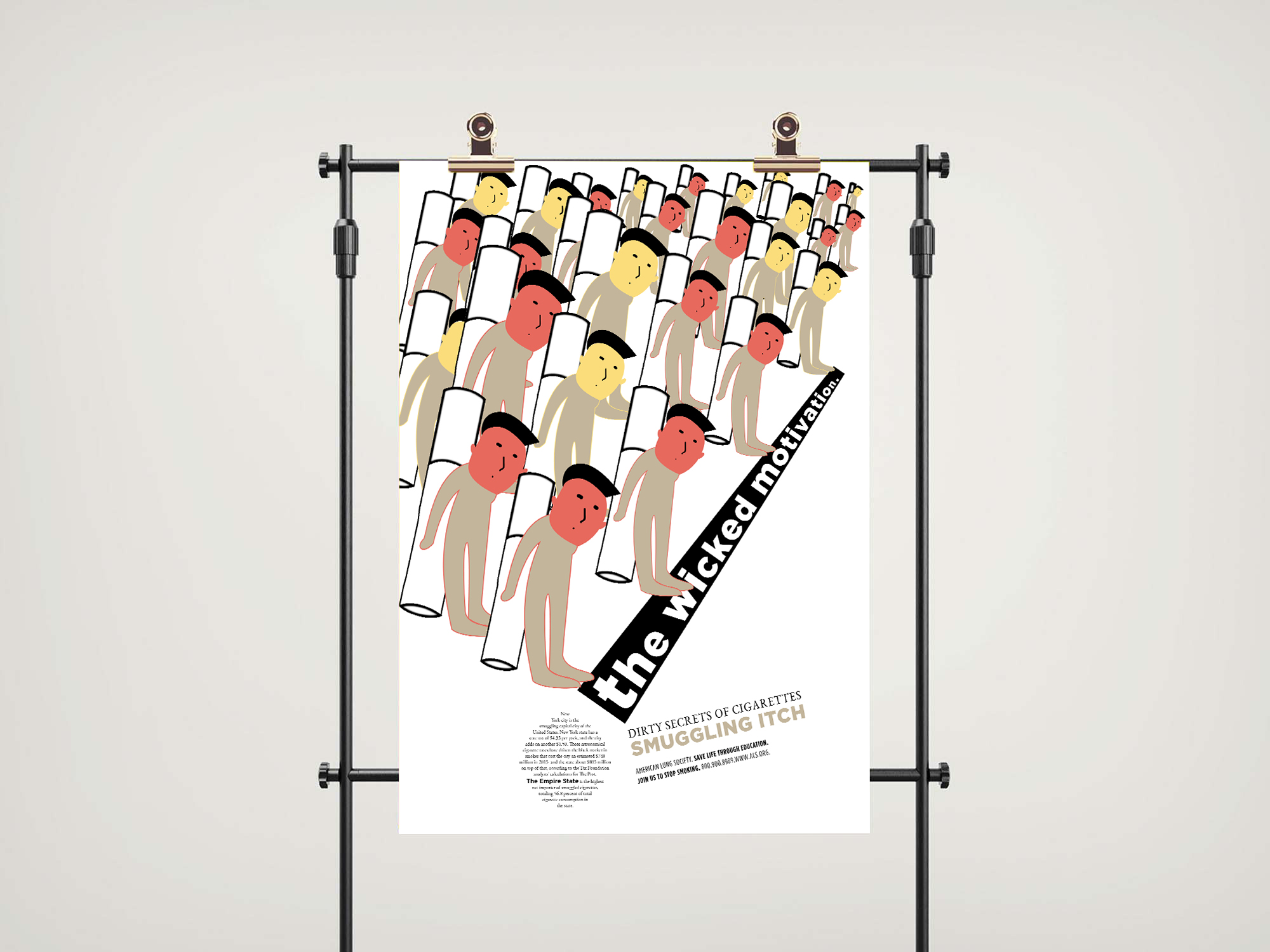
“Those astronomical cigarette taxes have driven the black market in smokes that cost the city an estimated $740 million in 2015 – and the state about $895 million on top of that…”
Gregory Bresiger, The New York Post
The impact of smuggling cigarettes is far beyond just tax evasion and lost government revenue. This is an industry that involves human trafficking, migrant abuse and exploitation, as well as child labour.
Our goal was to create a surrealistic graphic to illustrate the implications of smuggling cigarettes into different countries: Cigarettes are the owners, and we are the slaves.
2. An Addiction Scheme: The Incurable Drug
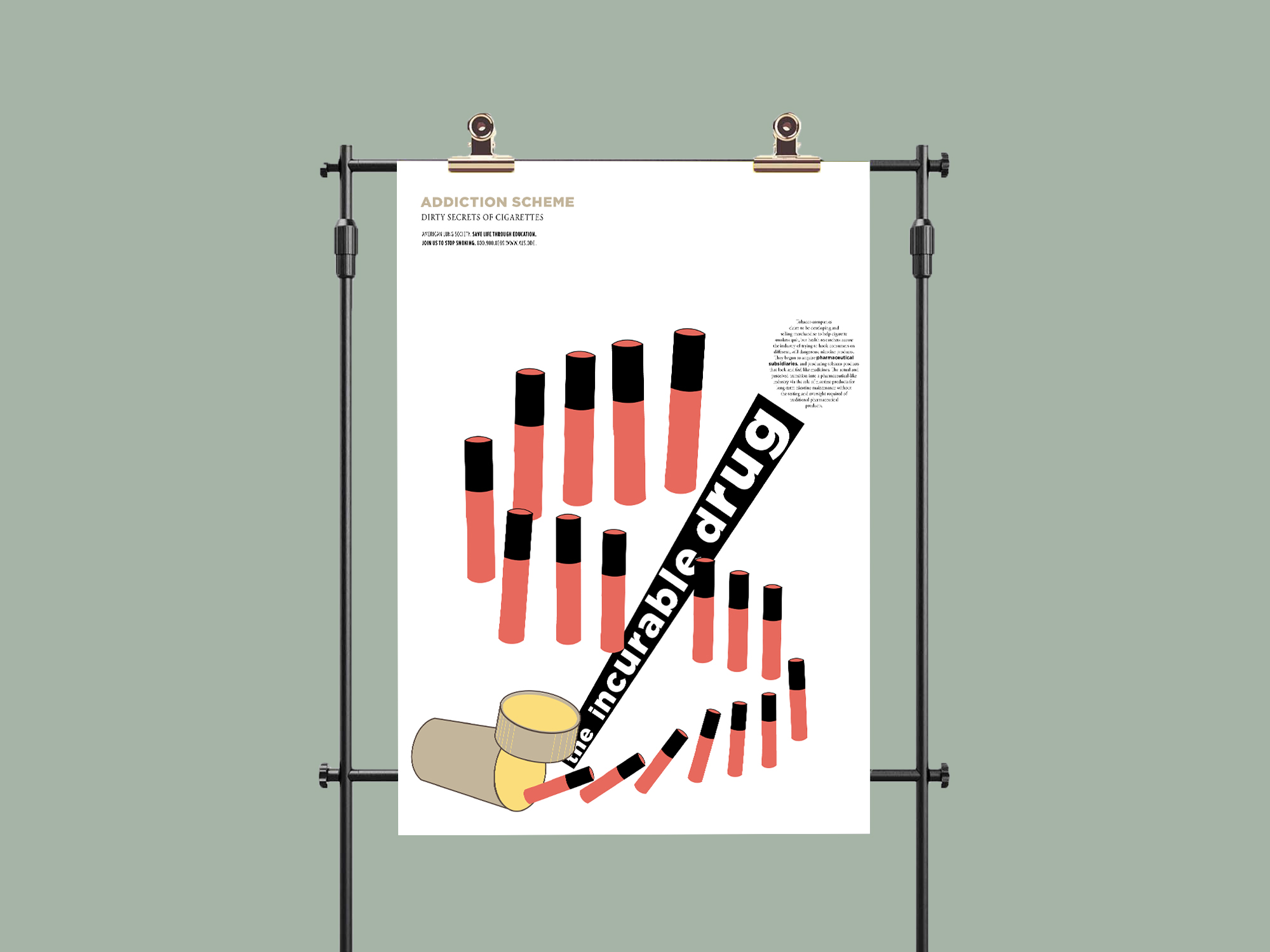
“Tobacco companies claim to be developing and selling merchandise to help cigarette smokers quit, but health researchers accuse the industry of trying to hook consumers on different – still dangerous – nicotine products.“
ROnnie cohen, Reuters health
During our research, we discovered that tobacco companies are acquiring pharmaceutical subsidiaries to produce medicine-like “noncombustible tobacco and nicotine products for smoking cessation or long-term nicotine maintenance” (source). This pharmaceuticalization underlines the tobacco industry’s active transition into a pharmaceutical one, by bypassing the standard testing and regulatory oversight required for pharmaceutical products.
The effort misleads the public by normalizing and popularizing the usage of nicotine, a “potently addictive and harmful drug” (source). Considering it’s addictiveness, every nicotine product we purchase in the name of tobacco cessation creates an endless domino effect that culminates in long-term nicotine maintenance.
3. Child Labour: The Hazardous Education
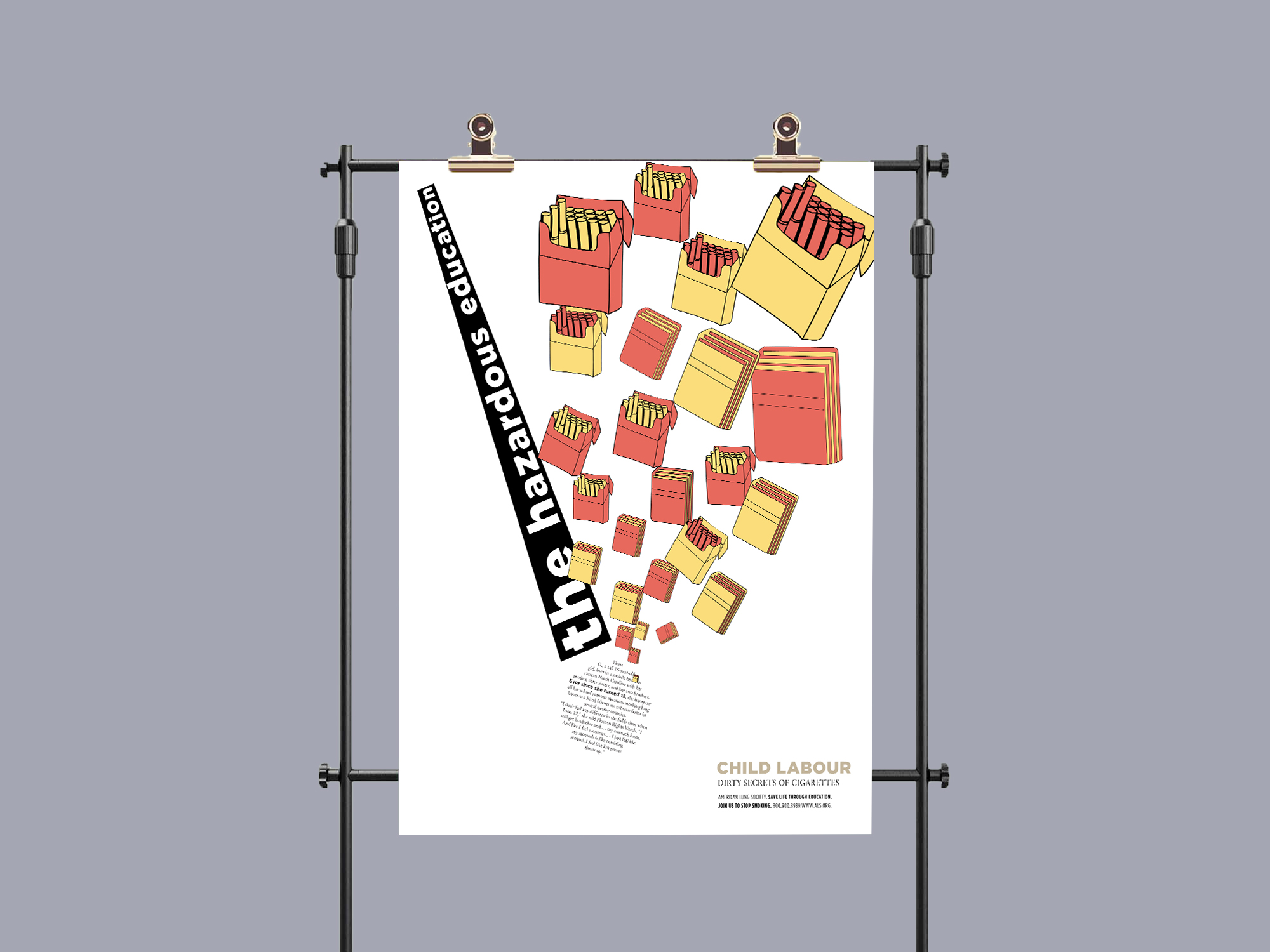
“I don’t feel any different in the fields than when I was 12,” she said. “I [still] get headaches and … my stomach hurts. And like I feel nauseous…. I just feel like my stomach is like rumbling around. I feel like I’m gonna throw up.”
Elena G., interview for Human Rights Watch
Child labour associated with the tobacco-industry is on the rise in developing countries. The oftentimes hard and harmful physical labour has contributed to a range of illnesses, including acute nicotine poisoning. This is an occupational poisoning that happens when children absorb nicotine through their skin as they come in contact with tobacco plants.
Therefore, to visualize what children are exposed to while working on tobacco fields, we arranged the graphics in a way to mimic the motion of smoke coming out of a burning cigarette.
Sponge
Email:
hi@sponge.design
Copyright © 2024 Sponge Design Inc.
 Sponge