ORGANIZATIONAL EQUITY
Accelerating organizational equity at scale
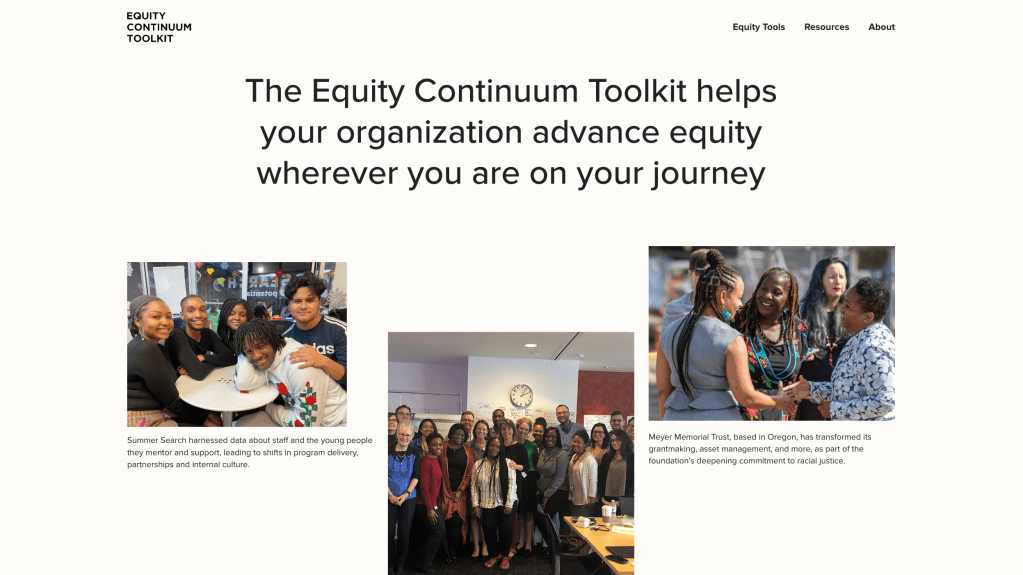
Public Equity Group (PEG) is a strategy and management consulting firm that helps purpose-driven organizations achieve impact in service of equity. To accelerate organizational equity at scale, PEG seeks our help in digitizing their Equity Continuum — a framework that draws from a decade of client work to help nonprofits and philanthropies confront systemic disparities and advance equity in their organizations. Together, we architected an intuitive and easy-to-use interactive digital interface that guides organizations through the “why” and “how”s of doing equity work, while mobilizing them towards action with tangibility and reassurance.
Developing a deep understanding of the framework and its users to inform our digital strategy
Used by several cohorts of community foundations and adopted by PEG’s senior consultants in their client work, the Equity Continuum has undergone continuous iterations to improve its usability, applicability, and effectiveness, with many lessons learned over the course of its development. Deepening our understanding of the framework’s evolution and the context behind it would help us successfully translate the framework into an actionable digital tool that organizations find relevant, easy to understand, and actionable. Guided by the research objectives below, we spent weeks conducting stakeholder interviews and market research, which culminated in several collaborative workshops to develop a digital strategy that guides organizations through the complex journey of advancing equity.
- Understand the Equity Continuum and its history to grasp the foundational framework we are reconstructing
- Understand the motivations, goals, needs, and pain points of target users to a) let users know they are in the right place, b) simplify the number of steps in achieving their goals, and c) design an experience that meets their needs and addresses their pain points
- Understand how users currently apply and interact with the Equity Continuum offline and identify areas, where they need guidance to design a digital interface that mirrors and optimizes for the types of interactions users would have offline; comparing this to the above can also help us uncover any misalignment between how it’s intended to be used and how users use it
- Identify positive and negative user experiences in the current process of applying or interacting with the Equity Continuum to amplify or leverage the positive and mitigate the negative
- Uncover the reasons behind the successes and failures of applying the Equity Continuum, and identify factors that lead to the most progress in advancing equity to optimize the interactions for success and effectiveness
- Learn about other tools or frameworks users find helpful in achieving their goals to understand what users like and dislike about their interactions with other tools, and incorporate the learnings into our design
A strategy that surfaces the unconscious and shifts from conceptual to tangible
Advancing equity entails working against 400 years of history, which has rendered much of the practices and norms that underpin systemic disparities unconscious. Despite organizations’ best intentions, the stealth nature of structural inequities makes it challenging for organizations to understand why and how they can be more equitable. Thus, uncovering and understanding where they are amplifying inequities unknowingly is a necessary first step that leads organizations to seek how to interrupt these disparities. Building on this research insight, our digital strategy is as much about unlearning as it is about learning.
A prominent barrier that halts constructive conversations around equity and change is the tendency for the narrative around this topic to bleed into the conceptual, and ideological realm. Viewing equity through an ideological lens, especially one that’s binary, triggers feelings of self-threat, leading to resistance and ultimately inaction. To mobilize organizations toward change, we need to move away from this intellectual concept of equity, and ask ourselves “how do we make equity tangible”. This is especially important if, as previously mentioned, we need to help organizations “see” the hidden drivers of disparity in their own organizational structures as the first step to advancing equity.
Translating our digital strategy into user-experience
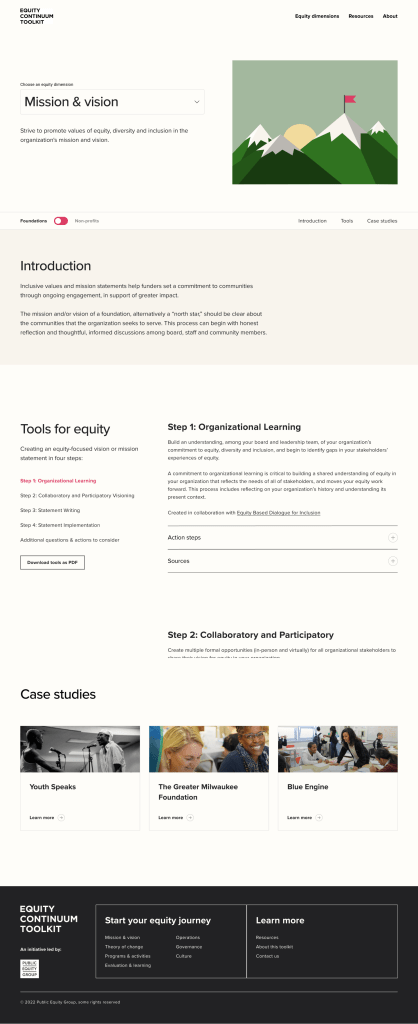
Building off our digital strategy to create an experience that is both awakening and tangible, we lead with quick and compelling statements that paint the big picture around the covert underpinnings of organizational inequities, making the case for why equity work is necessary; then ground this big picture in precise organizational contexts and drive action through examples and concrete steps. The result is an experience that deepens the commitment of those already committed to equity work while expanding the field to empower new believers to embark on this journey.
01 The big picture
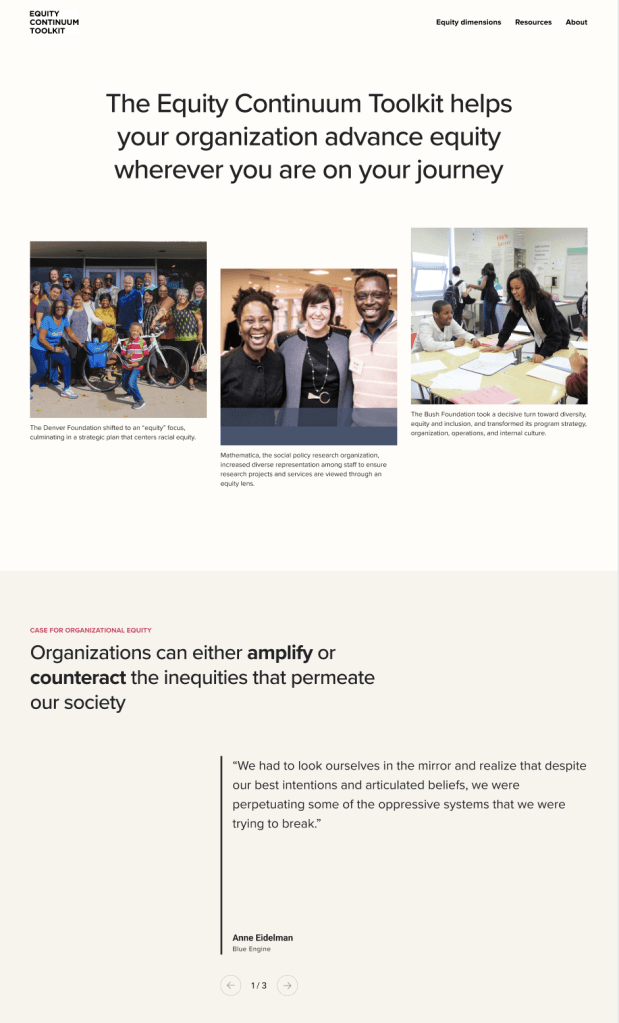
As previously mentioned, we see the widespread unconsciousness of long-standing practices and norms that perpetuate organizational inequities as not only an opportunity, but also a necessary first step in helping organizations understand where and how to take action to address these disparities. Designing for this opportunity, we use bold statements positioned on the homepage to bring awareness to this dimly lit area of organizational consciousness.
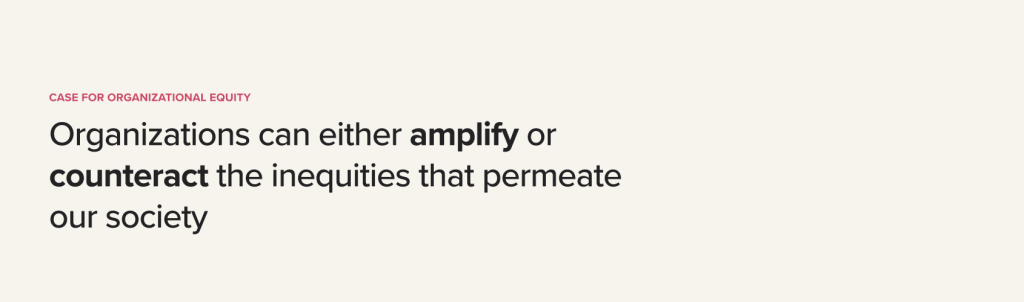
02 Fostering trust and courage through peers
We then follow up with quotes from leaders at prominent peer organizations that echo the statement to make it relatable and model the vulnerability required in acknowledging the previously unconscious.
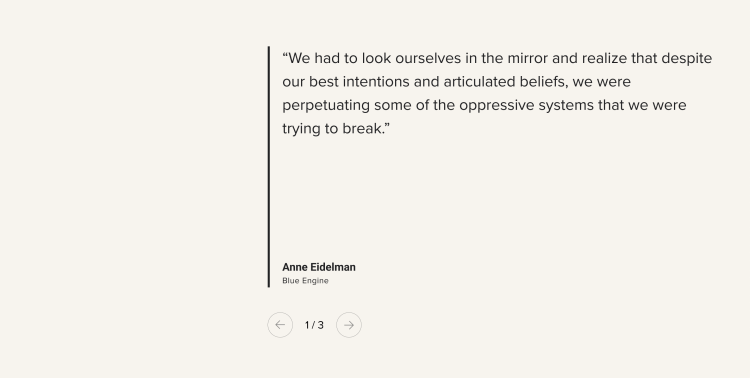
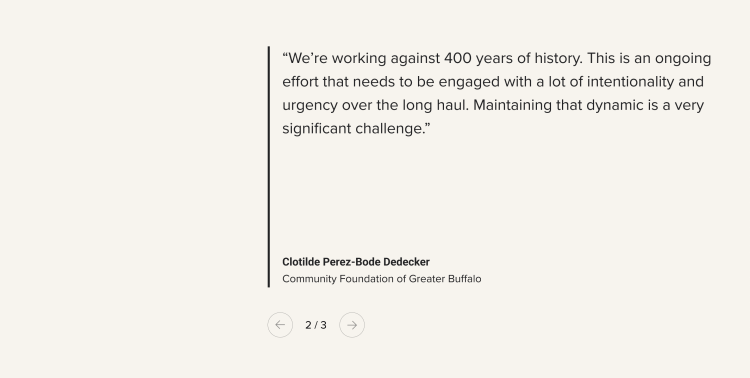
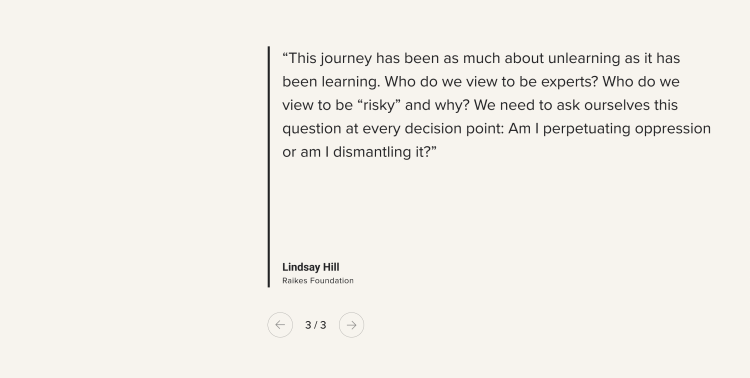
These are super good quotes. I love this headline — you can either amplify or counteract. It’s just powerful. I mean, it just makes me realize it’s our job to decide what we do.
Our testing feedback from one of the stakeholders
03 Grounding the big picture in concrete organizational contexts
Now that we’ve established a high-level understanding that organizations may unknowingly perpetuate inequities through routine practices and norms, the question then becomes “where exactly am I unconsciously amplifying these disparities”, and “how do I understand this in my own organizational context”. To address this, we recommended a content strategy that incorporates concrete and relevant examples of how peers became aware of the policies, norms, and practices that drive inequities in their organizations.
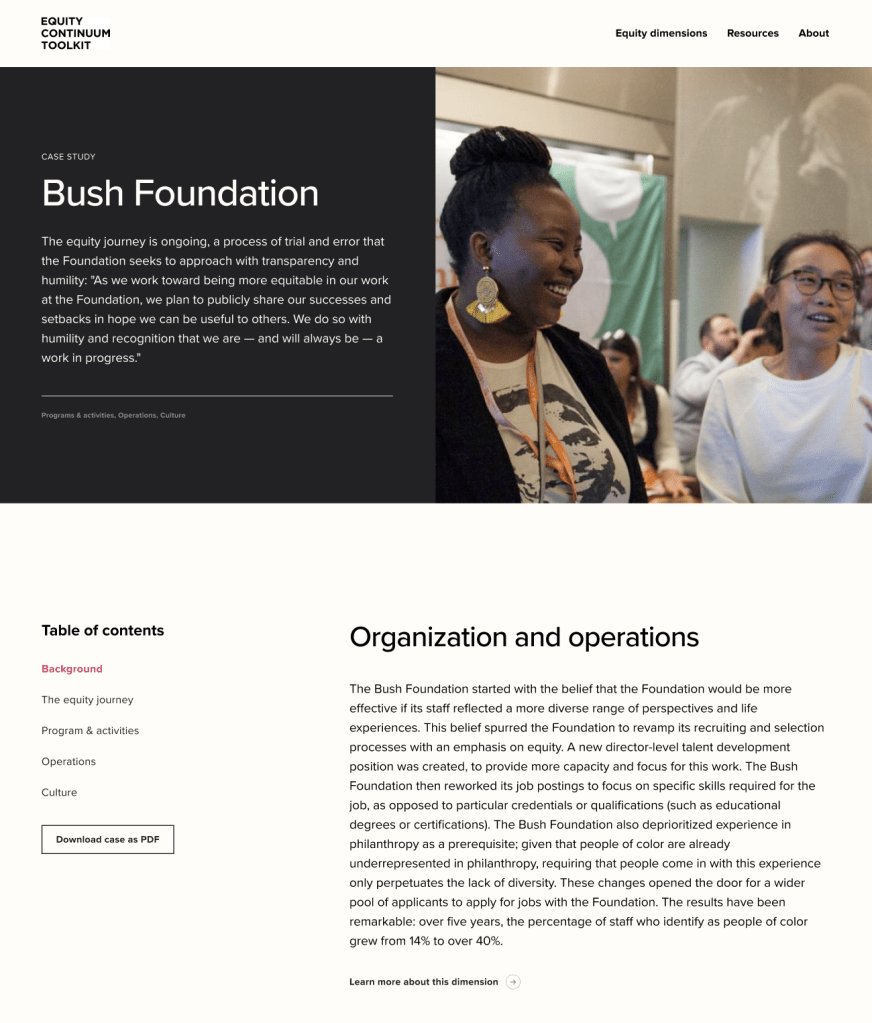
Visualizing an empowering space void of judgment
Equity has always been a sensitive topic. Doing the work takes courage as it requires confronting long-standing personal beliefs and behaviors. Especially when conversations around equity is often shrouded in an either/or narrative, this journey of internal confrontation may be riddled with perceived judgement against one’s moral character. In addition, with little individual understanding or experience in advancing equity, and the pressure to be seen as doing the right thing, leaders often feel uncertain and anxious along this journey, especially at the beginning.
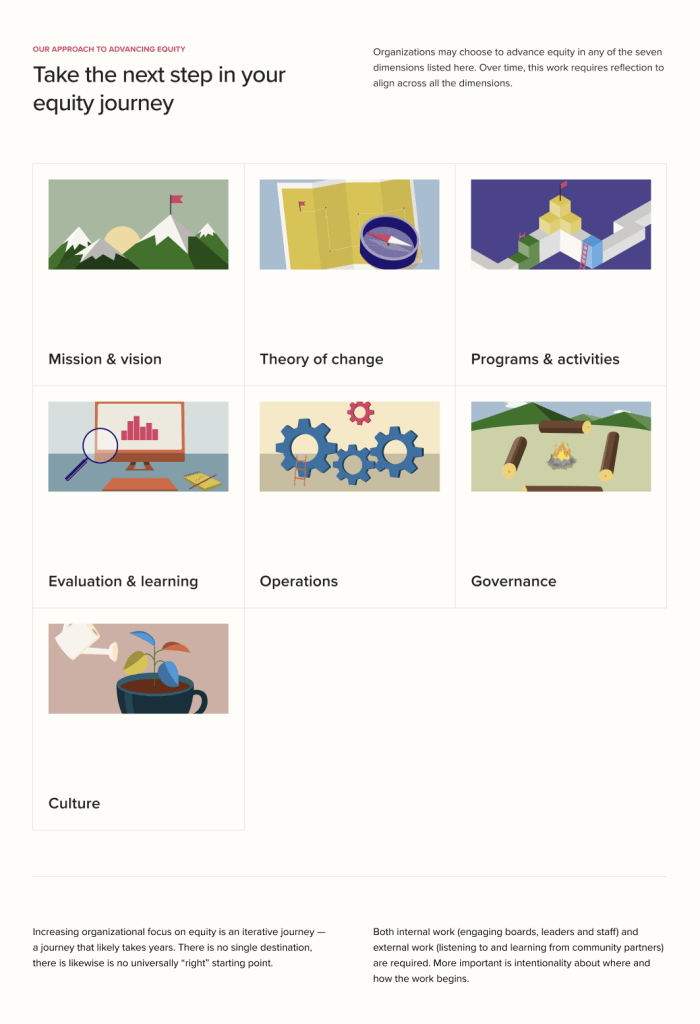
To architect an experience that meets individuals and organizations where they are with compassion and empowerment, while providing reassurance and fostering a feeling of ease, we updated and extended PEG’s visual identity with vibrant hues and complementary tints that don’t deviate from the current color palette.
With the same goals in mind, we also created a system of illustrations that incorporate 3D characteristics to add structure, which conveys practicality, actionability, and credibility. We ensured the simplicity of shapes and objects to counteract the users’ impression that advancing equity is complex and overwhelming, providing them with reassurance that it is indeed doable and achievable.
Sponge
Email:
hi@sponge.design
Copyright © 2024 Sponge Design Inc.
 Sponge